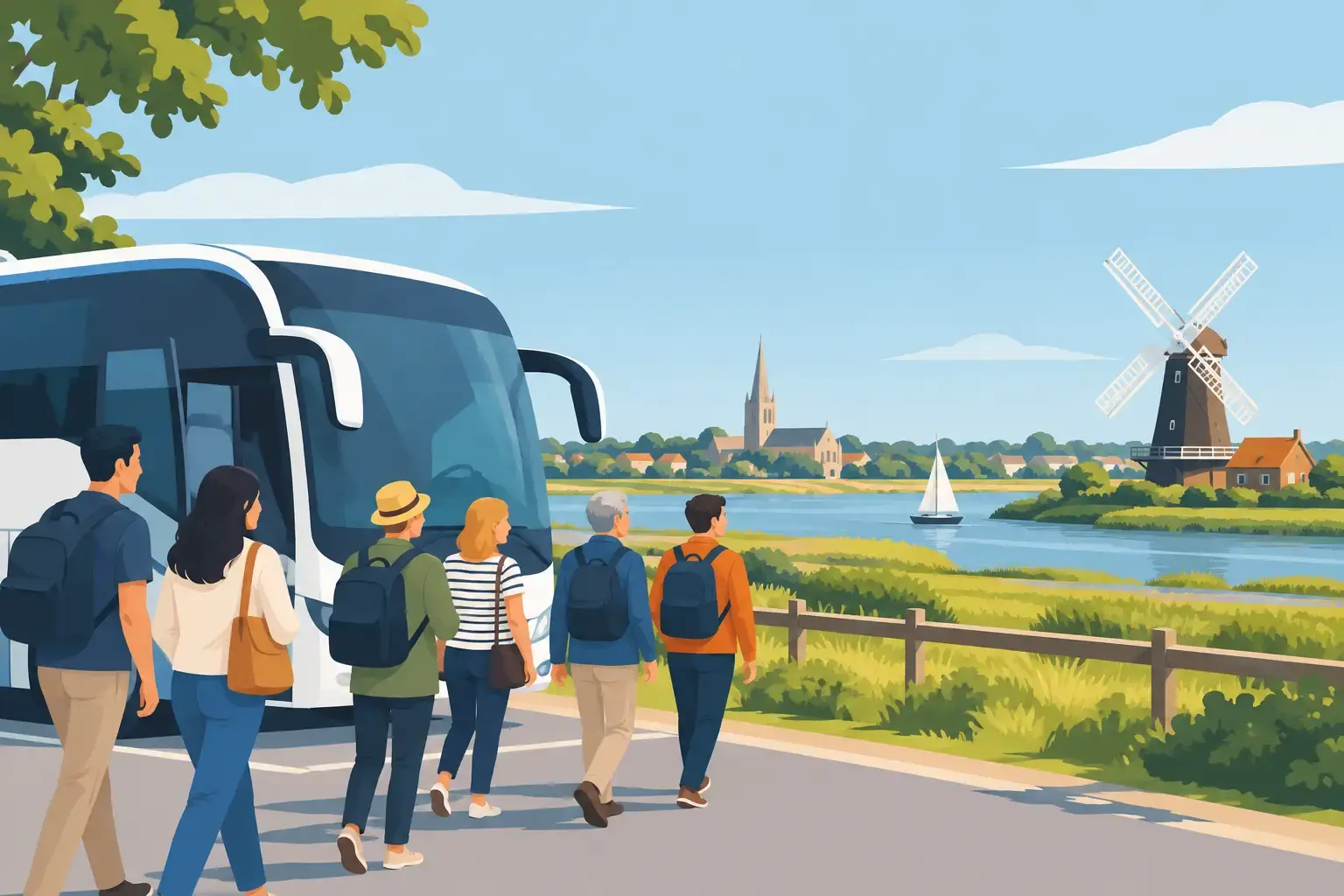
A full vehicle that is too large can make a simple journey needlessly expensive. One that is too small can leave passengers squeezed in, luggage piled around feet, or part of the group needing a separate lift. When deciding on minibus versus coach hire, the best choice comes down to more than passenger numbers. Your route, luggage, timing and the type of day you have planned all matter.
For families heading to the airport, colleagues travelling to an event, or holidaymakers arriving in Great Yarmouth, getting the vehicle right makes the whole journey easier from the start.
The main difference between a minibus and a coach
A minibus is usually the practical choice for smaller groups. In the UK, a minibus can carry between eight and 16 passengers, excluding the driver, although available seating layouts differ between operators. It is designed for groups that want to travel together without the cost or scale of a full-size coach.
A coach is generally built for larger parties and longer journeys. It may carry 20 passengers or far more, with more luggage space and facilities depending on the vehicle. Coaches are often the better fit for school trips, wedding guests, large corporate groups, sports teams and organised day trips.
The distinction is not simply about size. A minibus can be easier to collect from homes, hotels and holiday parks, and is more suited to local roads or limited parking. A coach offers extra room, but it also needs suitable access and a safe place to stop.
Start with passenger numbers, then allow room to spare
Count every traveller who will actually be in the vehicle, including children who need their own seat. Then think about whether the group may grow. A birthday meal, family gathering or airport run can easily pick up an extra passenger at the last minute.
If there are six to 12 people travelling locally with light bags, a minibus is usually a comfortable and affordable option. It keeps everyone together and avoids coordinating several cars or taxis. For a group of 14 to 16, a minibus may still work well, but the luggage requirement becomes much more important.
Once your numbers go beyond minibus capacity, a coach becomes the sensible option. It is also worth considering for smaller groups taking a long journey with substantial luggage. Booking a large coach for ten people may not be the most cost-effective choice, but booking a minibus with no room for cases is equally unhelpful.
Luggage can change the answer
For airport travel, luggage space is often the deciding factor. Ten passengers travelling with a small backpack each have very different needs from ten passengers with large suitcases, cabin bags, pushchairs and golf clubs.
Tell the operator how many cases you expect and whether you are carrying anything unusually bulky. This could include a wheelchair, pram, musical instrument, sports equipment or mobility aid. A vehicle may have enough seats on paper but still not have safe, usable space for everything you need to bring.
A coach usually has underfloor luggage storage, which makes it a strong option for bigger parties travelling longer distances. A minibus can be ideal for airport transfers too, provided the vehicle has been matched to both the number of people and their bags. Clear information at the booking stage prevents a stressful start to the journey.
Consider the journey, not just the destination
A short local trip and a four-hour journey call for different levels of space and comfort. For a restaurant booking, race day, family celebration or trip between nearby Norfolk villages, a minibus gives a group the convenience of travelling together without paying for unused capacity.
For longer journeys, passengers may appreciate the wider seating, additional legroom and larger storage associated with a coach. Some coaches also offer features such as toilets, air conditioning or onboard entertainment, although these should never be assumed. Ask what is included if those details matter to your group.
Route planning matters too. A full-size coach may not be able to reach every narrow lane, residential street or small hotel entrance. In busy seaside areas, access can be particularly restricted during peak holiday periods. A minibus is more flexible for door-to-door collections, multiple pick-ups and locations with tight turning space.
Minibus versus coach hire: compare the real cost
The cheapest quoted vehicle is not always the best value. Look at the total cost for the whole group, including waiting time, multiple pick-ups, parking, tolls where relevant and return travel. Dividing the total by the number of passengers often makes group transport far better value than several separate cars.
A minibus is normally more affordable for a modest-sized group because you are paying for a vehicle that suits your numbers. It may also reduce parking costs and make collections simpler. A coach can offer excellent value per person when every seat is needed, especially for a larger day trip or event.
Be cautious about choosing the smallest possible vehicle purely to reduce the fare. If passengers and bags do not fit comfortably, you may need a second vehicle anyway. The right choice is the one that carries everyone safely, on time and without unnecessary cost.
Think about pick-ups, accessibility and timing
Group travel tends to run more smoothly when the collection plan is simple. Decide whether everyone will meet at one location or whether you need several pick-ups. A single meeting point can reduce journey time, while door-to-door collections may be more convenient for families, older passengers or visitors unfamiliar with the area.
If anyone needs step-free access, extra assistance getting in or out, or space for a mobility aid, mention it before confirming the booking. The same applies to child seats. These arrangements are much easier to organise in advance than on the day of travel.
For flights, cruise connections, weddings and business appointments, build in sensible time for collections and traffic. An early departure is usually less frustrating than watching the clock in a queue. Pre-booking also gives the operator time to assign the right vehicle and plan the route properly.
Safety and reliability should be part of the decision
Whether you choose a minibus or a coach, the standard of the operator matters. Check that vehicles are properly licensed, insured and maintained, and that the driver is suitable for passenger transport. For family groups and organised events, professional driving standards provide reassurance that cannot be replaced by trying to coordinate several private cars.
Ask what happens if your journey is delayed, if a flight time changes, or if your return collection needs adjusting. A clear booking confirmation, agreed collection point and contact details help avoid confusion when the group is ready to travel.
For local minibus travel, Compass Taxis provides a practical option with fully licensed, DBS-checked drivers and maintained vehicles. Booking ahead is particularly useful for airport runs, resort transfers and busy weekends, when suitable group vehicles can be in demand.
Choose the vehicle that fits the occasion
A minibus is usually the right answer for airport groups with manageable luggage, family outings, hen or stag parties, work travel, restaurant trips and small groups visiting the coast. It is compact enough for local collections while keeping everyone in one vehicle.
A coach is normally better for large wedding parties, school or club outings, major events and long-distance travel with lots of passengers and bags. It provides the scale and storage that a minibus cannot always offer.
There are occasions where either could work. A group of 15 adults travelling a short distance with no luggage may be well suited to a minibus. The same 15 people travelling to an airport for a fortnight, each with a large case, may be more comfortable in a coach or require another luggage solution. Give the operator the full picture and ask for the vehicle they would recommend.
The simplest way to make a confident choice is to share your passenger number, collection points, destination, travel times and luggage details before you book. With the right information, your group can set off together, arrive comfortably and focus on the plans ahead rather than the transport behind them.